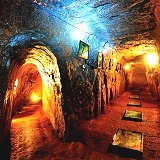
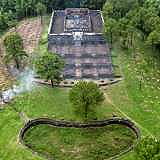
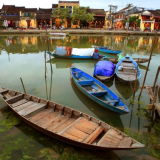
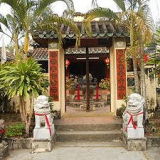
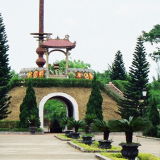
Địa đạo Vịnh Mốc is one of 114 large and small tunnels dug throughout Vinh Linh district, Quang Tri province. These 114 tunnels have a total length of nearly 42km. The Vinh Moc tunnel system was built in about 2 years, from 1965 to 1967. This is an underground tunnel system, including 3 main basements connected together to form a continuous system with a total length of more than 2,000m.
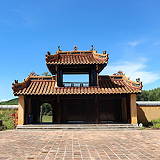
Lang Xuong Tho, also known as the Tomb of Queen Mother Tu Du, is a historic tomb located in Thuy Bang Village, Huong Thuy District, Thua Thien Hue Province, Vietnam. She was the wife of King Thieu Tri, mother of king Tu Duc, so her tomb is within King Thieu Tri's Mausoleum.
Phố cổ Hội An, or Hoi An Ancient Town, is a charming and well-preserved historic riverside town located in Hoi An, Quang Nam Province, Vietnam. It is renowned for its unique blend of architectural styles, cultural heritage, vibrant atmosphere and its history as a merchant trading post.
Duong so 28, Binh San, Ha Tien, Kien Giang, Vietnam
423 views 💖 2 👍 0
Lăng mộ Mạc Cửu is a historical site located in Binh San village, Ha Tien district, Kien Giang province, Vietnam. It is a significant cultural and historical landmark in the region.
49 Đường Hai Bà Trưng, Phường 2, Gò Công, Tiền Giang
122 views 💖 0 👍 0
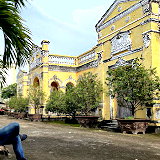
Dinh Đốc phủ Hải is a historic mansion located in Go Cong Town, Tien Giang, Vietnam. This architectural landmark is renowned for its unique blend of Eastern and Western styles, combining Vietnamese and French influences. Built around 1860, the house originally belonged to Đốc phủ sứ Nguyễn Văn Hải, a high-ranking mandarin during the Nguyen Dynasty.
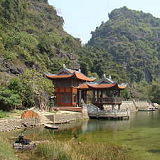
The Trang An Landscape Complex (Di Sản Tràng An), located in Ninh Binh Province, Vietnam, is a renowned UNESCO World Heritage Site recognized for its outstanding natural beauty and rich cultural history. The complex features a stunning landscape of limestone karst peaks, submerged valleys, and winding rivers, often referred to as "Halong Bay on land."
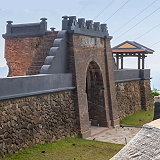
Hải Vân Quan is a historic military fortress located at the summit of Hải Vân Pass, on the border between Huế City and Đà Nẵng City. Built in 1826 under the reign of Emperor Minh Mạng of the Nguyễn Dynasty, it served as a strategic defensive structure to protect the imperial capital of Huế and control movement between the northern and central regions of Vietnam.
Tomb of Empress dowager Thuận Thiên (Lăng Bà Thuận Thiên Cao Hoàng Hậu) - Empress Thuan Thien, born Tran Thi Dang in Van Xa village, Huong Tra, Thua Thien, was the second wife of Emperor Gia Long of Vietnam and mother of Emperor Minh Mang.
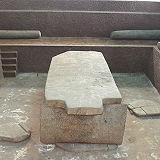
Hang Gon megalithic Tomb, also known as Mộ cự thạch Hàng Gòn, Di chỉ Hàng Gòn 7, Mộ Đông Dương, Mả Ông Đá, is a unique and remarkable historical site located in Long Khanh, Dong Nai Province, Vietnam. It is known for its distinctive tomb structure, which stands out due to its architectural design and the materials used. It is primarily made of stone, including massive stone slabs and columns.
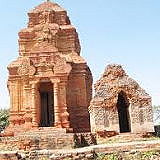
Bimong Po Rome (Tháp Po Ro Me), also known as the Po Ro Me Cham Towers, is a historical site located in Phuoc Huu, Ninh Phuoc District, Ninh Thuan Province, Vietnam. Similar to other Cham tower complexes, Thap Po Ro Me holds cultural and architectural significance as arelic of the Cham civilization's presence in the region.
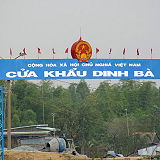
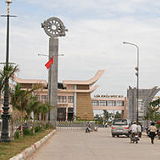
Dinh Ba international border gate (Cửa khẩu quốc tế Dinh Bà) is an international road border gate located in Tan Ho Co commune, Tan Hong district, Dong Thap province, Vietnam. Dinh Ba international border gate trades with Banteay Chakrei international border gate in Banteay Chakrei commune, Preah Sdach district, Prey Veng province, Cambodia.
Nha Cong tu Bac Lieu, or the Bac Lieu Mansion, is a historic and iconic building located in Bac Lieu, Vietnam. It is known for its architectural beauty and cultural significance. The mansion was built during the early 20th century and belonged to the affluent Ho family, who were prominent landlords and businessmen in the region.
Cao Lo Vuong Temple (Đền thờ Cao Lỗ Vương) is located on the mudflats along the Đuống River in Đại Trung village, Gia Bình, Bắc Ninh, Vietnam. This is the place to mark, commemorate and honor the military genius of the dawn of Vietnam's history, the person who helped King An Duong Vuong create the "magic crossbow", build Co Loa citadel to defeat Trieu Da's army and protect the Au Lac State.
Cao Lỗ temple (Đền thờ Tướng quân Cao Lỗ) is located in Thanh Hóa, Vietnam. Cao Lo was a Vietnamese weaponry engineer and minister who lived during the reign of King An Dương Vương. According to mythology, he built a crossbow from the claw of a turtle god that can fire 300 arrows in a single shot.
Đền Trần Thái Bình (Pantheon of Tran Dynasty) is a complex of relics including temples and tombs worshiping the kings of the Tran Dynasty located in Hung Ha, Thai Binh, Vietnam. The system of historical sites here, including the tombs and temples of the Tran kings, has been ranked as particularly important national monuments by the Vietnamese government.
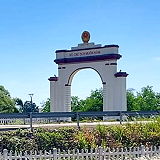
Cửa Khẩu Quốc Tế Mộc Bài (Moc Ba i International Border Gate) belongs to Tay Ninh Province, Vietnam. Its counterpart across the border is Bavet Border Gate, Svay Rieng Province, Cambodia.
Di tích Lịch sử Thành cổ Quảng Trị (Quang Tri Citadel) is an ancient fortress located in Quang Tri Province, central Vietnam. It was built in 1824 during the Nguyen Dynasty and served as a military stronghold to defend the Vietnamese border against invaders.
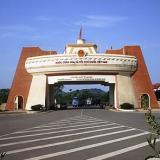
Cửa khẩu quốc tế Lao Bảo (Lao Bao Border Check Point) is an international border crossing located in Quang Tri Province, Vietnam. It serves as a major crossing point between Vietnam and Laos, specifically connecting Vietnam's Quang Tri Province with Laos' Savannakhet Province. The border crossing plays a crucial role in facilitating trade, travel, and transportation between the two countries.
Cầu Hiền Lương Vĩ Tuyến 17 is located in Gio Linh District, Quang Tri Province, Vietnam. This site is historically significant as it is associated with the Vietnam War (1955-1975). The Hien Luong Bridge itself was an important crossing point over the Ben Hai River, which served as the demarcation line between North and South Vietnam during the war.
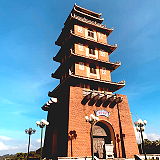
Bảo Tháp Khe Sanh (Khe Sanh Stupa) is a historical or cultural site located in Khe Sanh, Huong Hoa, Quang Tri, Vietnam. The stupa consists of 7 floors, 26m high, total floor area585m2, located in the Martyrs Cemetery area of Huong Hoa district.