Bao Vinh Old Town is a historic town located in the Hoa Chau ward of Hue city, Vietnam. The town is situated along the banks of the Perfume River and has a rich history dating back to the Nguyen Dynasty.
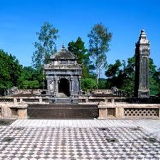
Emperor Tự Đức’s tomb is located in a narrow valley in Duong Xuan Thuong village (currently Thuong Ba village, Thuy Xuan Commune, Hue City). It is one of the most beautiful works of royal architecture of the Nguyen dynasty. The tomb lies in a boundless pine forest, 8 km from Hue. Its construction started in December 1864 and finished in 1867.
Duong Xuan Thuong III village, Thủy Xuân, Huế, Thành phố Huế
458 views 💖 5 👍 0
Chùa Từ Hiếu was originally a small hut built in 1843, who was formerly recognized by royal authority as the monk of Giac Hoang Pagoda. In 1848, the pagoda was restored by monk Cung Ky with the help of the king's eunuchs and courtiers. Tu Hieu hence became a large pagoda.
Núi Ngự Bình is a prominent mountain in Huế, Vietnam, standing 105 meters tall and located about 4 km from the city center. Its flat summit and symmetrical shape resemble a screen, making it a significant natural landmark alongside the Perfume River.
Ho Thuy Tien is an abandoned water park located in the Thuy Bang village of Huong Thuy district, Thua Thien Hue province, Vietnam. It was once a popular tourist attraction known for its unique architecture and vibrant features.
Emperor Đồng Khánh was the ninth emperor of the Nguyen Dynasty of Vietnam. He reigned three years between 1885 and 1889. He was born on March 20, 1864, in Hue, the capital city of Vietnam at the time and was another adopted son of Tu Duc who usurped the throne shortly after the French gained control of Hue. The tomb of Emperor Dong Khanh is the smallest.
Emperor Dục Đức’s burial ground is a small complex that also includes the graves of Emperors Thanh Thai and Duy Tan. Emperor Duc Duc was the 11th emperor of the Nguyen Dynasty in Vietnam. Interestingly, Duc Duc was imprisoned by the court for being a Francophile and he died after reigning only three days in 1883. He was born on September 2, 1852, in Hue, the capital city of Vietnam at the time.
Cầu ngói Thanh Toàn, also known as Thanh Toan tile-roofed bridge, is a historic covered bridge located in Lang Xa Bau Village, Huong Thuy District, Huế, Vietnam. Cau ngoi Thanh Toan is not only a functional bridge but also a cultural treasure that reflects the history and heritage of the local community.
Huế (formerly Thừa Thiên Huế province) is a southernmost coastal city in the North Central Coast region, the Central of Vietnam, approximately in the center of the country. After reorganization, Hue city has 40 administrative units at the commune level, including 21 wards and 19 communes.
Thiên An Hill (Đồi Thiên An) is a picturesque hill located about 10 km southwest of Huế, Vietnam. Nestled in Thủy Bằng commune, it features lush pine forests and winding paths, making it an ideal spot for photography and outdoor activities. The area is also home to the Đức Truyền Monastery, showcasing unique Asian architecture and serene surroundings.
Sông Hương, also known as Hương Giang, is a picturesque river flowing through Huế, Vietnam. It originates from the Trường Sơn Mountains and is approximately 80 km long, with its most scenic section extending 30 km from Bằng Lãng to Thuận An. The river is celebrated for its emerald waters and tranquil beauty, reflecting the rich cultural heritage of the region.
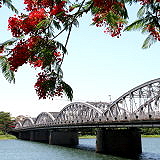
Nguyen Hoang Bridge (Cầu Nguyễn Hoàng) is a newly constructed bridge spanning the Perfume River (Sông Hương) in Huế, Vietnam. It is a notable addition to the city's infrastructure and has become a new landmark due to its unique and symbolic design. The bridge is 380 meters long and 43 meters wide.
Phu Loc town, Loc Tri commune, and Loc Binh commune will be reorganized into Phú Lộc commune. The township is located in the middle between the cities of Huế and Da Nang, to the south of Tam Giang – Cầu Hai lagoon and at the foot of Bạch Mã National Park. Phu Loc Hue is a popular destination for cultural tourism, eco-tourism, spiritual tourism, lake and sea tourism.
Phong Điền is ward of Huế city in the North Central Coast region of Vietnam. Arrange the entire natural area and population size of Phong Thu ward, Phong My commune and Phong Xuan commune into a new ward called Phong Dien ward.
Phu Da town, Phu Gia commune, and Vinh Ha commune will be reorganized into Phú Vang commune of Huế in the North Central Coast region of Vietnam. Phú Vang belongs to the low-lying land with a large size of lagoons. This area is divided into two main sections: the river and the sand dunes.
The wards of An Dong, An Tay, and An Cuu have been merged into An Cựu ward. With its historical significance, vibrant market, and ongoing urban growth, An Cựu is an attractive area for both locals and visitors exploring Huế.
Quoc Hoc High School for the Gifted - Truong Trung hoc Pho thong Quoc Hoc - is a prestigious educational institution located in Hue, Vietnam. It is known for its long history, academic excellence, and the significant role it has played in Vietnamese education.
Trường THPT Hai Bà Trưng is a secondary and high school located in Thuan Hoa Ward, Hue City, Vietnam. Truong THPT Hai Ba Trung offers education at both the secondary (lower and upper) and high school levels. Students typically begin their studies at the lower secondary level (grades 6-9) before moving on to the upper secondary level (grades 10-12).
Vườn Quốc Gia Bạch Mã is a protected area located in Hue city in central Vietnam. It covers an area of over 37,000 hectares and includes a diverse range of ecosystems, including tropical forests, grasslands, and mountain peaks.
Tháp Chăm Phú Diên, also known as My Khanh Tower, is a tower located in My Khanh village, Phu Vang, Hue city. The tower was accidentally discovered in April 2001 by a mining company. The tower was then located 5-7 m deep in the sand, 3-4 m below the sea level and only 120 m from the sea coast.