Greece (13 Administrative Regions)
9 Mainland Regions
Attica (Capital: Athens)
Central Greece (Capital: Lamia)
Central Macedonia (Capital: Thessaloniki)
Eastern Macedonia and Thrace (Capital: Komotini)
EpirusEpirus (Capital: Ioannina)
Peloponnese (Capital: Tripoli)
Thessaly (Capital: Larissa)
Western Greece (Capital: Patras)
Western Macedonia (Capital: Kozani)
4 Island Regions
Crete (Capital: Heraklion)
Ionian Islands (Capital: Corfu)
North Aegean (Capital: Mytilene)
South AegeanSouth Aegean (Capital: Ermoupoli)
Greece »
»
| Holy Monastery Hilandar | |
| The Holy Monastery of Hilandar, located on the Athos Peninsula in Greece, is one of twenty Eastern Orthodox monasteries on Mount Athos. Surrounded by dense forests, the monastery complex is an architectural marvel, blending Byzantine and Serbian styles. The monastery houses a rich collection of religious artifacts, manuscripts, and icons. | |

| Holy Monastery of Simonopetra | |
| The Holy Monastery of Simonopetra is one of the most striking monasteries on Mount Athos, Greece. Built on a sheer cliff approximately 330 meters above the Aegean Sea, this Eastern Orthodox monastery appears to float on the water, creating an unforgettable spectacle with its majestic cliff architecture. Founded in the 13th century by Saint Simon the Perfumer, the monastery is dedicated to the Nativity of Christ. | |

| Central Macedonia | |
| Central Macedonia is one of the thirteen administrative regions of Greece, encompassing the central part of Macedonia geographically and historically. With a population of 1,795,669 in 2021, it is the second most populous region in Greece after Attica. The region's capital and largest city is Thessaloniki. | |

| Thessaloniki Waterfront | |
| Residents and visitors can enjoy a walk or a run along the Waterfront of Thessaloniki, which is about five kilometers in length, from the Concert Hall to the port. The waterfront is linear and relatively limited in width, giving it the characteristics of a narrow beachfront. | |

| Archaeological Museum of Thessaloniki | |
| The Archaeological Museum of Thessaloniki is one of the largest museums in Greece and the central museum of northern Greece. All visitors are welcome to experience its unique collections of ancient artefacts as well as its rich and extrovert cultural activities. | |

| White Tower of Thessaloniki | |
| The White Tower in Thessaloniki is an architectural and museum structure located on the riverfront of Thessaloniki. The White Tower houses a new permanent exhibition about Thessaloniki from its founding in 316/15 BC to the present day. The exhibition summarizes the historical aspects of the city, which is notable for its long and continuous historical presence. | |

| Blue Caves Villas | |
| The magnificent Blue Caves are in the north of the Greek Ionian island of Zakynthos. the blue caves are only accessible by the sea. The biggest cave is called Kianoun, and there are, in general terms, many boats available for rent in the town port for tourists to be able to get to the blue caves. | |

| Kastania Cave | |
| Kastania Cave, also known as the Kastania Cave of Agios Andreas, is one of Greece's most impressive and lesser-known natural wonders. It is located near the village of Kastania in the southeastern Peloponnese, within the region of Laconia. This cave is celebrated for its rich geological formations and captivating underground scenery. | |

| Melissani Cave | |
| The cave of Melissani is located near Karavomilos on the island of Kefalonia. It is a lacustrine cave of unique beauty and fully developed cave, which is 3.5 km long, 40m wide and 36m high. Melissani cave constitutes a unique geological phenomenon. It was created by a mechanical and chemical process called karstikopoiisi (dissolution of rocks) during which water enters the calcareous rocks, erodes them and creates hollows. | |

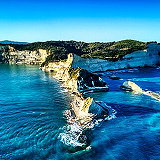
| Corfu | |
| Corfu is one of the islands in the Ionian archipelago off the west coast of Greece. The island's population was 101,600 in 2021. Within the Ionian archipelago, the Corfu administrative unit extends south to Paxoi. Its capital and largest city is also named Corfu. | |
| Mount Zas | |
| With its highest peak reaching 1,004 meters (or 3,000 feet), Mount Zas, located 18 km from the town of Naxos, is the highest mountain in the Cyclades archipelago. It's no surprise that Zeus, the father of the Greek gods, was raised here, while his son, Dionysus, the god of wine and pleasure, was also raised here, specifically in a cave on the mountain known as the Zas Cave. | |

| Monastery of the Holy Trinity | |
| Perched on a nearly vertical cliff, the Holy Trinity Monastery is perhaps Meteora's most impressive sanctuary, often appearing to float in mid-air. Historically, access to the monastery was via a rope basket, followed by a climb of 140 carved steps. The monastery gained worldwide fame after its appearance in the James Bond film "For Your Eyes Only". | |

| Ancient Agora of Athens | |
| The Agora was the center of Athenian democracy, the site of the city's most important political events, and a place where both Pericles and Socrates walked. Visitors can explore the ruins of the ancient Agora, the remarkably well-preserved Temple of Hephaestus, and the reconstructed Stoa of Attalos, located at the foot of the Acropolis, in a site of outstanding natural beauty. | |

| Greece | |
| Greece is a country in Southeast Europe. It is situated on the southern tip of the Balkans, and is located at the crossroads of Europe, Asia, and Africa. The country consists of nine traditional geographic regions, and has a population of approximately 10.7 million. Athens is the nation's capital and largest city, followed by Thessaloniki. | |

| Museum of the Royal Tombs | |
| The Aigai archaeological site is a World Heritage site and a place of outstanding natural beauty. The Aigai site includes the Multi-Century Museum, palaces, city, castles and surrounding areas built by the ancient Macedonian kingdom at Aigai. | |

| Temple of Hephaestus | |
| The Temple of Hephaestus, the god of blacksmithing, is a well-preserved Greek temple built in 449 BC by Iktinos as a dedication to Hephaestus; it still stands almost intact today. It is a Doric temple with surrounding porticoes, located northwest of the Athenian Agora, atop the Agoraios Kolonos hill. | |

| Areopagus Hill | |
| Areopagus is a barren marble hill situated opposite the entrance to the Acropolis. Its ancient marble steps can be slippery, especially in the rain. Near the foot of the steps is a bronze stela inscribed with the Greek text of Paul's sermon. From the top of the hill, there are stunning views of the Acropolis. | |

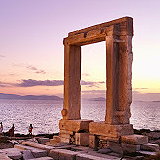
| Temple of Apollo | |
| The Temple of Apollo is an ancient Greek temple in Naxos dedicated to Apollo. It was built in the 6th century BC by the tyrant Lygdamis. It is located on the islet of Palatia at the northern end of the port of Naxos. The temple is 59m long and 28m wide, with the entrance located on the west side of Naxos – an unusual feature for an Ionian-style temple. | |
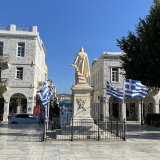
| Miaouli Square | |
| Miaouli Square is a square in the city of Ermoupolis, Syros Island, Greece. It is the historic square of Syros with architectural wonders blending into the poetic landscape of the 19th century, with buildings that testify to the existence of a great civilization. | |
| Acheron Springs | |
| Acheron Springs is a hidden gem. Its natural beauty attracts visitors from all over the world. It is also a destination with many organized activities for both adults and children such as rafting, kayaking, canyoning, sailing, archery and horse riding. | |
