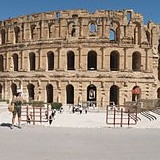
The Amphitheatre of El Jem, also known as the Colosseum of Thysdrus, is an ancient Roman amphitheatre located in the town of El Jem, Tunisia. It is one of the most impressive and well-preserved Roman amphitheatres in the world and is a UNESCO World Heritage site.
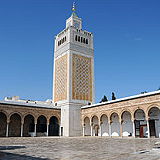
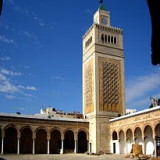
The Ez Zitouna Mosque, also known as the Great Mosque of Tunis, is a significant religious and historical landmark located in the heart of the Medina (old city) of Tunis, Tunisia. It is considered one of the oldest and largest mosques in Tunisia and North Africa.
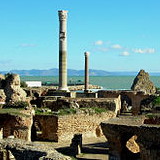
The Baths of Antoninus or Baths of Carthage, located in Carthage, Tunisia, are the largest set of Roman thermae built on the African continent and one of three largest built in the Roman Empire. They are the largest outside mainland Italy. The baths are also the only remaining Thermae of Carthage that dates back to the Roman Empire's era. The baths were built during the reign of Roman Emperor Antoninus Pius.
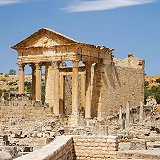
Dougga, located near the town of Teboursouk in northern Tunisia, is one of the most well-preserved Roman archaeological sites in North Africa and a UNESCO World Heritage Site. Known for its impressive ruins and historical significance, Dougga provides a unique glimpse into the life of an ancient Roman city.
Tunisia is a country located in North Africa. It is bordered by Algeria to the west and Libya to the southeast, with the Mediterranean Sea to the north and east. Tunisia is known for its rich history, diverse culture, and beautiful landscapes. it covers 163,610 km2 (63,170 sq mi), and has a population of 12.1 million.
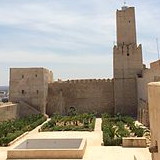
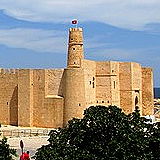
The Ribat of Sousse is a historical site located in the city of Sousse, Tunisia. It is a fortified monastery or fortress that dates back to the 9th century and is considered one of the best-preserved examples of Islamic military architecture in the Mediterranean region.
The archaeological site of Oudhna is located 30 kilometers south-west of Tunis, in the valley of Oued Miliane, known since Antiquity for its fertile soil. Human occupation of the region dates back to pre-Roman times, but the foundation of the town took place at the end of the first century B.C. when a new colony was created, inhabited by veterans of the 13th Roman legion.
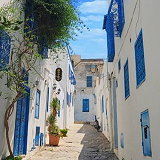
Sidi Bou Said is a town in northern Tunisia located about 20 km northeast from the capital, Tunis. The town itself is a tourist attraction and is known for its extensive use of blue and white. It can be reached by a TGM train, which runs from Tunis to La Marsa. Its population was 6,000 in 2023.
Sidi Belhassen Chedly Mausoleum is a mausoleum in Tunisia, located near the Jellaz cemetery south of Tunis. It is one of the most known and iconic soufi Saints of Tunis. The mausoleum consists of two sites, the Kabira Mamiyya tourbet is located on the highest point of the hill.
The Ribat of Monastir, located in Monastir, Tunisia, is a historic Islamic fortress or stronghold with religious and military significance. Ribats were typically used as defensive structures during the early centuries of Islam, and they also served as centers for Islamic education and spiritual retreats.
The Archaeological Site of Carthage, located in Carthage, Tunisia, is a significant and historically rich area recognized as a UNESCO World Heritage Site since 1979. Situated on the coast of the Mediterranean, Carthage was originally founded by the Phoenicians in the 9th century BCE and became one of the most powerful cities of the ancient world. The site holds layers of history, showcasing influences from the Phoenician, Punic, and Roman civilizations.
The Great Mosque of Kairouan, located in Kairouan, Tunisia, is one of the most important and oldest mosques in the Muslim world, dating back to 670 CE. Founded by the Arab general Uqba ibn Nafi, it holds a revered place in Islamic history and architecture and is considered one of the holiest sites in North Africa. The mosque has been listed as a UNESCO World Heritage Site due to its architectural and cultural significance.
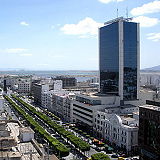
Tunis is the capital and largest city of Tunisia, a country situated in North Africa. It is located along the Mediterranean Sea, in the northeastern part of Tunisia. Tunis is a vibrant city with a rich history and a unique blend of cultures, making it a fascinating destination for travelers. It had a population of 602,560 in 2022.
The Sousse Archaeological Museum is one of Tunisia’s most important museums, located in the coastal city of Sousse. It houses a remarkable collection of ancient artifacts, with a particular focus on the region’s Punic, Roman, and early Christian periods. The museum is situated within the Kasbah of Sousse, a historical fortress overlooking the city and the Mediterranean Sea.
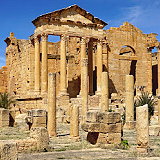
Sbeitla is a small town in central-western Tunisia, 250km from Tunis. It is famous for its unique Roman ruins and the Capitol, which includes not one but three temples dedicated to Minerva, Jupiter, and Juno, the patron goddesses of Rome.