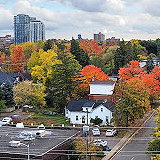
Burlington is a city located on the western shore of Lake Ontario in the province of Ontario, Canada. As of 2021, the city had a population of 186,948. Visitors to the city will find a very convenient lakeside area to walk to, leading to the nearby Brant Street Pier, where they can enjoy local restaurants, many with terraces overlooking the lake, as well as the Joseph Brant Museum, galleries, and theaters.
The Royal Botanic Gardens is a heritage-listed botanical garden located in the cities of Burlington and Hamilton in the province of Ontario, Canada. The garden encompasses extensive protected areas, historical monuments, and culturally significant gardens stretching from Burlington to Hamilton.
Although the concrete dam created a nearly insurmountable barrier for fish on their upstream journey, volunteers and nature lovers worked together to create the Bowmanville Creek Fish Ladder. This fish ladder is a bypass that allows trout and salmon to bypass the dam.
Bowmanville is a community of approximately 60,000 people located within the Clarington Township, Durham Region, Ontario, Canada. It is situated about 75 km east of Toronto. The downtown area of Bowmanville boasts nearly 200 shops, restaurants, and services catering to visitors.
Waterloo is a city in the province of Ontario, Canada. It is one of three cities in the Waterloo Metropolitan Area. Waterloo is located approximately 94 km southwest of Toronto. Waterloo remains an independent city. According to the 2021 census, the population of Waterloo was 121,436. The downtown area, known as Uptown Waterloo, is home to over 400 restaurants, shops, and services.
James Island is a town in Charleston County, South Carolina. It is located in the central and southern part of James Island. James Island is part of the Charleston, South Carolina metropolitan area and the Charleston urban area.
Sullivan's Island is a town and island in Charleston County, South Carolina, located at the entrance to Charleston Harbor, with a population of 1,791 in 2010 and 1,891 in 2020. The town is part of the Charleston metropolitan area and is considered a very affluent suburb of Charleston.
York is a city and the county seat of York County, South Carolina. Its population was estimated at 7,736 in the 2010 census and increased to 8,053 in the 2020 census. York is located approximately 27 miles (43 km) southwest of Charlotte.
North Myrtle Beach is a city in Horry County, South Carolina. It is located approximately 24 kilometers northeast of Myrtle Beach and is one of the major tourist destinations along the Grand Strand.
Surfside Beach is a town in Horry County, South Carolina. Its nickname is "Family Beach." The population is 4,155 according to the 2020 census, up from 3,837 in 2010. It is considered part of the Grand Strand.
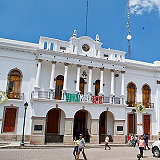
Jalisco, officially the Free and Sovereign State of Jalisco, is one of 31 states, along with Mexico City, that make up Mexico's 32 Federal Territories. The state's population was 8,348,151 in 2020. The highest elevation in Nevado de Colima is 4,260 m (13,980 ft). The state capital and largest city is Guadalajara.
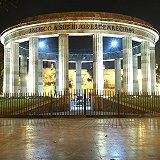
Guadalajara is the capital and most populous city of the state of Jalisco in western Mexico. According to the 2020 census, the city had a population of 1,385,629, while the Guadalajara metropolitan area had a population of 5,268,642.
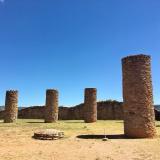
La Quemada is an archeological site, also known as Chicomoztoc. It is located in the Villanueva Municipality, in the state of Zacatecas, about 56 km south of the city of Zacatecas on Fed 54 Zacatecas-Guadalajara, in Mexico.
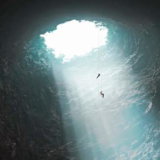
The Cave of Swallows, also known as Sotano de las Golondrinas in Spanish, is a massive natural cave located in the state of San Luis Potosi, Mexico. It is named after the thousands of white-collared swifts and green parakeets that nest inside the cave during the breeding season.
Zacatecas, officially the Sovereign and Free State of Zacatecas, is one of Mexico's 31 states. Its population was 1,622,138 in 2020. The state is divided into 58 municipalities, with Zacatecas City as its capital.