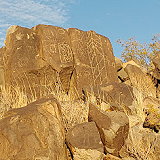
The Three Rivers rock carvings are outstanding examples of prehistoric rock art from the Jornada Mogollon people. The basalt mountain range rising above the Three Rivers Valley contains over 21,000 rock carvings, including masks, sunbursts, wildlife, handprints, and geometric patterns. The sheer number and density of the carvings make this one of the largest and most interesting rock art sites in the American Southwest.
Bandelier National Monument protects over 33,000 acres of rugged but beautiful canyon and mesa country. The monument preserves the homes and territory of the Ancestral Puebloans of a later era in the Southwest. Most of the pueblo structures date to two eras, dating between 1150 and 1600 AD.
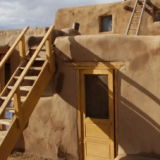
Taos Pueblo is an ancient pueblo belonging to a Taos speaking Native American tribe of Pueblo people. It is approximately 1000 years old and lies about 1 mile north of the modern city of Taos, New Mexico.
For thousands of years, groups of nomads used the caves above Cliff Dweller Creek as temporary shelter. In the late 1200s, people of the agricultural Mogollon (Southern Ancestral Pueblo) culture made it a home. They built rooms, crafted pottery and raised children in the cliff dwellings for one or two generations. By approximately 1300, the Mogollon had moved on, leaving the walls behind.
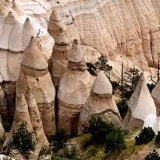
Kasha-Katuwe Tent Rocks National Monument, located 40 miles southwest of Santa Fe, New Mexico (near Cochiti), is a Bureau of Land Management (BLM) managed site that was established as a U.S. National Monument by President Bill Clinton in January 2001 shortly before leaving office. Kasha-Katuwe means "white cliffs" in the Pueblo language Keresan.