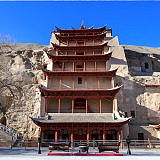
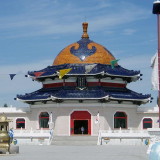
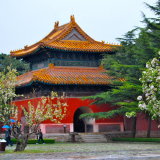
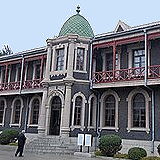
The Mogao Caves, also known as the Mogao Grottoes or the Caves of the Thousand Buddhas, are a renowned UNESCO World Heritage site located near the city of Dunhuang in Jiuquan, Gansu Province, China. These caves are famous for their exceptional Buddhist art and are one of the most significant archaeological and cultural treasures in China.
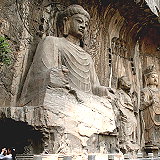
Longmen Grottoes or Longmen Caves are some of the finest examples of Chinese Buddhist art. Longmen Grottoes are housing tens of thousands of statues of Buddha and his disciples, they are located 12 kilometres (7.5 mi) south of present-day Luoyang in Henan province, China.
The Cao Cao Mausoleum, also known as the Gaoling Mausoleum of Wei and the Xigaoxue Tomb No. 2, is a tomb in Xigaoxue Village, Anfeng Township, Anyang County, Anyang City, Henan Province, China. It is purported to be the burial site of Cao Cao (155–220 CE), a prominent warlord who lived in the late Eastern Han dynasty.
Mutianyu Great Wall has a long history and a splendid culture. Located 70 kilometers away from the center of Beijing, it is one of the famous sections of the Great Wall in Beijing and represents the essence of the Ming Dynasty's Great Wall. Mutianyu Great Wall is renowned both domestically and internationally and is praised as an outstanding section of the Great Wall.
The Yulin Caves, built since North Wei Dynasty (356AD-534AD), is a Buddhist cave temple site located in Guazhou, Gansu Province. It is the sister caves of the Mogao Cave and about 170km away from it. There are 43 existing caves in the Yulin Caves, with a total of 5,200 square meters of murals and more than 259 colored sculptures.
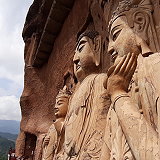
The Maijishan Grottoes, formerly romanized as Maichishan, are a series of 194 rock-cut caves cut into the Maijishan hill in Tianshui, Gansu Province, northwest China. They contain over 7,200 Buddhist sculptures and over 1,000 square meters of murals.
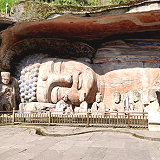
The Dazu Rock Carvings are a series of Chinese religious sculptures and carvings located in Dazu District, Chongqing, China. The carvings date back as far as the 7th century AD, depicting and influenced by Buddhist, Confucian and Taoist beliefs.
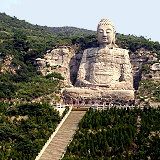
The Mengshan Giant Buddha is a stone statue located in the north peak of Mengshan Mountain, Taiyuan and built during the Northern Qi dynasty. Initially discovered in a 1980 census, the statue was found to have its head missing. From 2006 to 2008, people constructed a 12-meter tall head for the statue. The site opened to the public on October 2008.
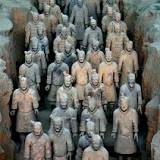
Emperor Qin Shi Huang's Mausoleum Site Museum, also known as the Terracotta Army Museum, is a significant archaeological site located in the Lintong District of Xi'an, Shaanxi Province, China. The Terracotta Army or the "Terracotta Warriors and Horses" is a collection of terracotta sculptures depicting the armies of Qin Shi Huang, the first Emperor of China.
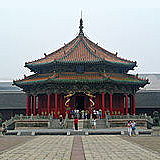
Mukden Palace was the former imperial palace of the early Manchu-led Qing dynasty. It was built in 1625 and the first three Qing emperors lived there from 1625 to 1644. Since the collapse of imperial rule in China, the palace has been converted to a museum that now lies in the center of Shenyang city, Liaoning province.
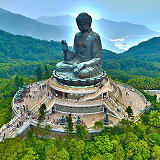
The Tian Tan Buddha, also known as the Big Buddha, is a massive bronze statue located on Lantau Island in Hong Kong. It is one of the largest seated outdoor Buddha statues in the world and a significant cultural and spiritual landmark.
Tiananmen Square, located in the heart of Beijing, China, is one of the largest public squares in the world, covering an area of about 109 acres (44 hectares). It is a symbol of China's national identity and has been the site of numerous significant historical events.
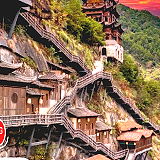
Reputed as a real-life version of a fantasy world, Wangxian Valley offers a profound journey through the harmonious trio of natural landscapes, human heritage, and legendary tales that transcends the ordinary. Here, it invites all who wander its paths to step into a story where every nook is a verse, every vista a painting, and every moment an ode to the enduring dance of nature, culture, and myth.
Jianshui is a charming town made-up of historic buildings. Built during the Tang Dynasty and boasting a history of over 1200 years, Jianshui Ancient Town is famous worldwide for housing over 50 immaculately preserved buildings, that mix the Han and the local ethnic styles, thus known as the “Ancient Building Museum” and “Folk Residence Museum.”
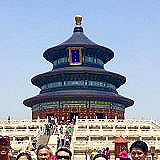
The Forbidden City was the Chinese imperial palace from the Ming dynasty to the end of the Qing dynasty. It is located in the center of Beijing, China, and now houses the Palace Museum.
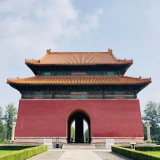
Xianling Tomb of the Ming Dynasty (tomb of Emperor Hongxi, the fourth emperor of the Ming Dynasty of China). The Ming tombs are a collection of mausoleums built by the emperors of the Ming dynasty of China.
The Imperial Palace of Manchukuo, also known as the Manchukuo Imperial Palace, was a grand architectural complex located in Changchun, China. It served as the official residence of Puyi, the last Emperor of China, who was installed as the ruler of the puppet state of Manchukuo by the Japanese during their occupation of Northeast China in the 1930s.