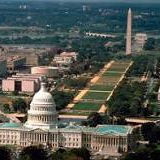
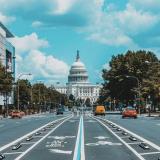
The National Mall is centrally located in Washington, DC, stretching over 2 miles from the Lincoln Memorial on the west end to the U.S. Capitol on the east end. The National Mall is America’s most visited national park, where the past, present and future come together. The monuments and memorials in this park honor American forefathers and heroes who paid the ultimate sacrifice in service to this country.
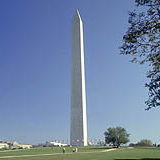
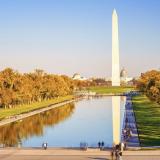
The Washington Monument is an obelisk on the National Mall in Washington, D.C., built to commemorate George Washington, a Founding Father of the United States, victorious commander-in-chief of the Continental Army from 1775 to 1783 in the American Revolutionary War, and the first president of the United States from 1789 to 1797.
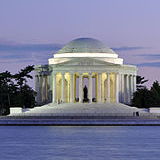
The Jefferson Memorial is a national memorial in Washington, D.C., built in honor of Thomas Jefferson, the principal author of the United States Declaration of Independence, a central intellectual force behind the American Revolution, a founder of the Democratic-Republican Party, and the nation's third president.
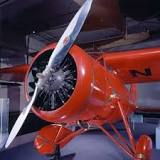
The National Air and Space Museum of the Smithsonian Institution is a museum in Washington, D.C., in the United States, dedicated to human flight and space exploration. It has the Largest collection of historic aviation and space artifacts in the world.
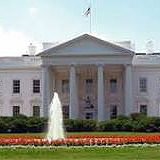
The White House is the official residence and workplace of the president of the United States. It has served as the residence of every U.S. president since John Adams in 1800 when the national capital was moved from Philadelphia. "The White House" is also used as a metonym to refer to the Executive Office of the President of the United States.
The United States National Arboretum is an arboretum in northeast Washington, D.C. It is 446 acres (1.80 km2) in size and is located 2.2 miles (3.5 km) northeast of the Capitol building, with entrances on New York Avenue, NE and R Street, NE. The campus's gardens, collections, and features are connected by roadways that are 9.5 miles (15.3 km) long in total.
Washington, D.C., formally the District of Columbia, is the capital city and federal district of the United States. The city is on the Potomac River, across from Virginia, and shares land borders with Maryland to its north and east. Washington had an estimated population of 702,250 as of 2024.
The Library of Congress is a research library in Washington, D.C., serving as the library and research service for the United States Congress and the de facto national library of the United States. It is the largest library in the world, with millions of books, recordings, photos, maps and manuscripts in our collections.
The Corcoran School of the Arts & Design at the George Washington University prepares its graduates to be the next generation of global leaders. Part of the Columbian College of Arts and Sciences, the school functions as an incubator for artists, designers and scholars, who learn from internationally renowned faculty at the intersection of creativity and social innovation.
The John F. Kennedy Center for the Performing Arts, commonly known as the Kennedy Center, is a major performing arts venue in Washington, D.C., USA. It is located on the Potomac River, adjacent to the Watergate complex. The Kennedy Center serves as a national cultural center and a living memorial to President John F. Kennedy.
The National Zoological Park, commonly known as the National Zoo, is one of the oldest zoos in the United States. The zoo is part of the Smithsonian Institution and does not charge admission. Founded in 1889, its mission is to "provide engaging experiences with animals and create and share knowledge to save wildlife and habitats".
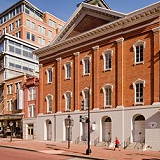
The site of the April 14, 1865, assassination of President Abraham Lincoln, Ford's Theatre is a working theatre, historical monument, world-class museum and learning center. The theatre produces musicals and plays reflecting the unique, diverse character of American life.
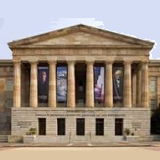
The National Portrait Gallery's collections present people of remarkable character and achievement. The Gallery is dedicated to the exhibition and study of portraits of people who have made significant contribution to American history and culture.
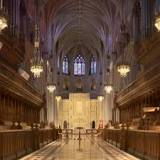
Washington National Cathedral is a cathedral of the Episcopal Church. The cathedral is located in Washington, D.C., the capital of the United States. The structure is of Neo-Gothic design closely modeled on English Gothic style of the late fourteenth century. Over 270,000 people visit the structure annually.
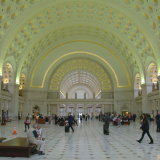
Washington Union Station is a major transportation hub and historic train station located in Washington, D.C., USA. Union Station opened in 1907 and was designed by architect Daniel Burnham. It was constructed to consolidate the city's various railroad terminals into one grand station.
The World War II Memorial is a memorial of national significance dedicated to Americans who served in the armed forces and as civilians during World War II. It is located on the National Mall in Washington, D.C.
The Vietnam Veterans Memorial is one of the most-visited memorials in the nation's capital. Millions come each year to pause and reflect in front of the black granite of The Wall, find the names of loved ones, make rubbings of those names and leave behind tributes to those they lost.
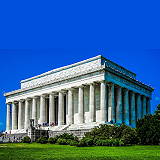
The Lincoln Memorial is a US national memorial built to honor the 16th president of the United States, Abraham Lincoln. It is on the western end of the National Mall in Washington, D.C., across from the Washington Monument, and is in the form of a neoclassical temple.
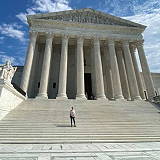
The Supreme Court of the United States is the highest court in the federal judiciary of the United States. It has ultimate appellate jurisdiction over all U.S. federal court cases, and over state court cases that turn on questions of U.S. constitutional or federal law. Completed in 1935, it is situated in Washington, D.C.
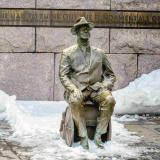
The Franklin Delano Roosevelt Memorial is a presidential memorial in Washington D.C., dedicated to the memory of Franklin Delano Roosevelt, the 32nd President of the United States, and to the era he represents.